
Beyond the usual tourist trail discovering the craft, quiet corners, old streets and wild heart of Jaipur.
when people say Jaipur, most of us immediately picture Hawa Mahal glowing pink in the morning sun, Amber Fort standing proudly on the hills and colourful markets filled with block prints and jewellery,
But Jaipur has another personality.
It lives in narrow lanes where artisans still make things by hand. It hides inside old stepwells where the city suddenly becomes quiet. It appears in a forgotten tower above a busy bazaar, in stone-carving workshops tucked inside residential lanes and in forests where leopards roam surprisingly close to the city. If you have already seen the postcard version of Jaipur, this is the Jaipur I would recommend exploring next.Come curious, wear comfortable shoes and leave some room in your itinerary for getting pleasantly lost.
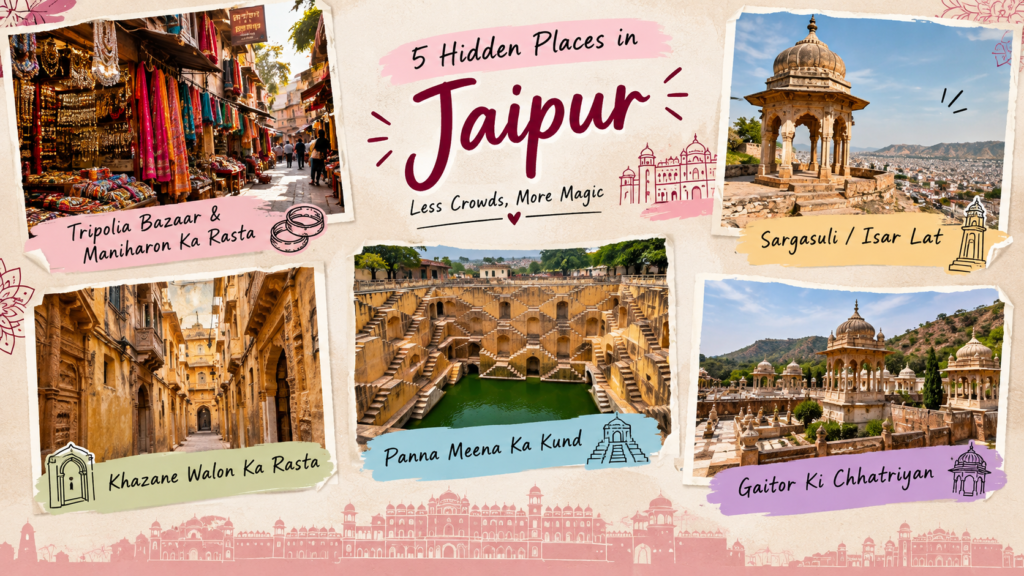
1. Tripolia Bazaar & Maniharon Ka Rasta
A place where a shopping trip turns into a little history lesson.If Jaipur’s streets could tell stories, Tripolia Bazaar would probably have the most.Tripolia Bazaar is one of the historic markets of Jaipur’s walled city. Jaipur itself was founded by Maharaja Sawai Jai Singh II in 1727, and Tripolia was among the major bazaars developed as part of the original planned city. Historical records indicate that the main markets, including Tripolia, were established during the early years of the walled city.
The name comes from Tripolia Gate, traditionally understood as a triple-arched gateway. The gate was associated with the royal precinct and ceremonial processions, giving this otherwise bustling market a rather regal beginning.
Today, Tripolia is wonderfully chaotic.You’ll find lac bangles, brassware, ironware, textiles, carpets, jewellery and traditional handicrafts.But don’t just walk along the main road rather look for the smaller raastas lanes historically associated with particular trades and that brings us to my favourite discovery:
Maniharon Ka Rasta “The Lac Bangle Lane”
Hidden within the Tripolia Bazaar area is Maniharon Ka Rasta, famous for its lac bangles.
The lane takes its name from the traditional bangle-making community, and local accounts connect the settlement of bangle artisans with Jaipur’s founding-era craft traditions. Some accounts say artisans were invited to Jaipur during Sawai Jai Singh II’s reign. And this is where shopping becomes an experience.Instead of simply picking up a finished bangle, look for a workshop where you can watch the artisans work.
The lac is heated and shaped, then decorated with colours, stones, beads and other embellishments. The result is something wonderfully traditional but still incredibly wearable.
What to explore:-
- Handmade lac bangles
- Traditional jewellery
- Brass and metalware
- Textiles and fabrics
- Carpets and durries
- Local handicrafts
- Small traditional shops and old façades
- Artisan Workshop
How to reach:-
Tripolia Bazaar is in Jaipur’s Walled City, close to the City Palace and Tripolia Gate.
You can reach it by:
- Auto-rickshaw
- Cab
- Local bus
- Jaipur Metro, followed by a short walk/auto connection from the old-city station.
Badi Chaupar Metro Station is one useful access point; Tripolia Bazaar is roughly 600 metres away according to current local transit information.
When to go:-
Individual shops keep their own hours, but roughly 10 AM-7 PM is a practical shopping window. Avoid Monday if you’re specifically going for shopping, as some shops may be closed.
Best time: October-March, preferably late morning or late afternoon.
2. Sargasuli / Isar Lat
The tower hiding in plain sight, you could walk through Tripolia Bazaar and completely miss one of Jaipur’s most interesting landmarks.
Look upwards.
There it is.
Sargasuli, also known as Isar Lat or Swarg Suli – the “heaven-piercing” tower.It was built in 1749 by Sawai Ishwari Singh, son of Jaipur’s founder, to commemorate a military victory. Rajasthan Tourism describes it as a 60-foot-high tower near Tripolia Gate offering panoramic views of Jaipur.
The story becomes even more interesting because Ishwari Singh’s victory was connected to a succession struggle following the death of Sawai Jai Singh II. The tower’s elegant vertical form stands out against the much lower pink-city streets.
What to explore:-
- The historic tower itself
- Its architecture and staircase
- Views over the old city, where accessible
- Tripolia Bazaar
- Nearby old-city streets
- The relationship between the tower and Jaipur’s a original city grid
How to reach:-
It is near Tripolia Gate, right in the Walled City.The easiest way is by auto/cab to Tripolia Bazaar and then walking around the area.
Timing:-
Opening/access arrangements can change, so check locally before planning an interior climb. The tower is best combined with a Tripolia-Maniharon Ka Rasta walk.
Best time: late afternoon, when the old city begins to glow.
3. Khazane Walon Ka Rasta
The street where Jaipur turns stone into art,this is one of those places that doesn’t initially look like a “tourist attraction”. And that’s exactly why I love it.
Khazane Walon Ka Rasta is a living craft neighbourhood famous for its stone-carving tradition.
The story goes back to Jaipur’s early development. Skilled artisans were brought into the walled city, and a settlement known as Silawaton Ka Mohalla developed around stone workers. As the artisan community grew, the lanes expanded into what became known as Khazane Walon Ka Rasta.
UNESCO has documented a 1.6-km Stone Crafts Heritage Walk through this area, beginning at Chandpole Gate and passing through artisan demonstrations, havelis, temples and historic neighbourhoods.This is not a place where you simply tick off one monument.
You walk.
You observe.
You listen to the sound of tools hitting stone.You watch a rough piece of material slowly become a sculpture.
Things to explore:-
- Stone-carving workshops
- Artisan demonstrations
- Traditional havelis
- Old temples
- Jaipur’s historic streetscape
- Hand-carved architectural pieces
- The UNESCO-documented heritage walk
How to reach:-
A good starting point is Chandpole Gate.From there, you can walk into the Khazane Walon Ka Rasta area.Auto-rickshaws and cabs can drop you near Chandpole.
Little tip:-
Don’t treat this like a shopping mall.These are working artisan neighbourhoods. Ask before photographing artisans or entering workshops.
4. Panna Meena Ka Kund
The stepwell where six friends suddenly stop talking.Near Amber Fort sits one of Jaipur’s most photogenic hidden corners:
Panna Meena Ka Kund.
Dating to the 16th century, the stepwell is famous for its striking geometric arrangement of stairs. It was designed as a practical water structure but also functioned as a community gathering place.
Its exact origin story is less firmly documented than the architecture itself, so I would avoid repeating the popular legend that confidently attributes its construction to one specific person.
What is certain is that the stepwell represents Rajasthan’s ingenious response to water scarcity.And then there is the atmosphere.The stairs seem to create endless patterns.From above, they almost look like a giant geometric artwork.
What can you do here?
- Admire the symmetrical staircase design
- Photograph the architecture
- Sit quietly and take in the surroundings
- Combine it with Amer Fort
- Explore the surrounding Amer heritage area
And honestly,Sit there for a few minutes.Don’t immediately reach for your phone.The quietness is part of the experience.
How to reach:-
Panna Meena Ka Kund is near Amer Fort, roughly 10-11 km from central Jaipur.
A cab or auto is the easiest option. It is also easy to combine with Amer Fort, Jaigarh Fort and Jal Mahal in the same sightseeing day.
Timing:-
There is no consistently published official tourist timetable comparable to major ticketed monuments; access is generally during daylight hours.
Best time: early morning or late afternoon. Avoid the harsh summer afternoon.
5. Gaitor Ki Chhatriyan
Where Jaipur’s royal history becomes beautifully quiet
If the crowds of Jaipur ever become too much, head towards Gaitor.
Gaitor Ki Chhatriyan is the royal cremation ground and cenotaph(Empty tomb) complex associated with the Kachhwaha rulers of Jaipur.The site was established in the 18th century, during the era of Jaipur’s founding, and successive rulers added their own beautifully carved memorials.
The word chhatri means canopy, and that’s exactly what these structures resemble-elegant domed memorials supported by intricately carved pillars.Marble,Sandstone,Floral motifs,Carved figures,Domes.Everything feels delicate against the surrounding hills.
Things to explore:-
- Royal cenotaphs
- Intricate marble carving
- Domes and pillars
- Architectural details
- The surrounding Aravalli landscape
- A quieter side of Jaipur’s royal heritage
The site is maintained with basic visitor facilities and security, according to Rajasthan’s Nahargarh Eco-Sensitive Zone documentation.
How to reach:-
Gaitor lies near the foothills of Nahargarh, off the road connecting the old city towards the fort area.A cab or auto is the easiest option.
Timing:-
Timings can vary, so check locally before travelling. Plan a daylight visit, particularly if you are exploring independently.